Tuesday, May 8, 2012

EGGS!

A recent meal I had that I enjoyed was scrambled eggs yesterday morning from the omelet bar in Nelson dining hall.  I started with three fresh eggs.  Then I asked to have ham, green peppers, and tomatoes added.  Kimberly, my favorite omelet chef, threw all my vegetables on the skillet.  Once they were heated she poured the eggs on.  We made some casual conversation, the eggs cooked up, and cheese was added.  I then turned it into a sandwich; the breakfast was delicious.  I came away from the dining hall feeling like a champion.  I was ontop of the world, a delicious meal in my stomach, high in protein, and probably other healthy things that are part of that non-fat breakfast.  The main components of this meal, the eggs, are what I will be examining.
It turns out that jungle eggs were the first known eggs to be domesticated.  By 3200 B.C.E. India was domesticating these eggs(Kritchevsky, 558).  The world hadn’t upgraded to the now-famous chicken egg yet; but we were well on our way.  “The first domesticated fowl reached North America with the second voyage of Columbus in 1493. (Kritchevsky, 558)”  The eggs folks ate way back when surely weren’t those of chickens, or consistently, but none-the-less they were undoubtedly eggs.  Hen's eggs are the most common source of egg nutrition. In 1989 the three largest egg-producing countries were China (140,900 × 106 eggs), Russia (84,600 × 106 eggs), and the United States (67,042 × 106 eggs)(Kritchevsky, 560).”  Hen’s eggs might be the most common, and might be what I ate, but other types of eggs are eaten around the world.  Take caviar for example.  Those are eggs.  And they definitely don’t come out of a hen.  People still enjoy them, but they made a much different type of food.  They make a food with less cooking options.  A hen’s egg can be poached, scrambled, cooked over easy, omelet-tized, and not to mention the possibilities of baking with an egg. 
There is big controversy over what is happening with factory farming of chickens.  It is my belief that this factory farming is mainly for their meat and not for the eggs.  Before the 1920s chicken meat was not common in the American diet. Female chickens were valued on the farm for egg production(Farm, 71).  Chicken meat is a huge part of the American diet.  Today at lunch I had the choice of a chicken or steak burrito.  At dinner they were serving chicken as well.  Its everywhere.  Christopher Cook claims that boneless chicken is the most popular and also the most labor intensive.  The conditions in factory farms aren’t just bad for the animals, but also for the workers.  They are often injured due to the unsafe conditions and high expectations that they are forced to meet.
Laying hens are much different than the broiler chickens that are harvested for their meat.  Here is some information about the economics of these mass produced animals.


(Farm, 58)


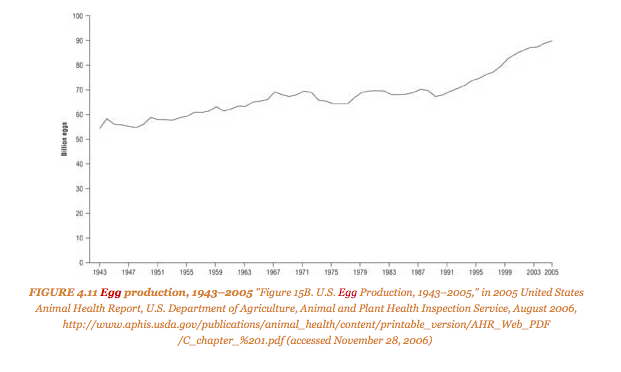
These 343.5 million laying hens produced nearly 90,000,000 eggs in 2005. See figure below.


(Farm, 73)
With laying hens only the females are valuable.  The males are of no value because they can not produce sufficient body meat compared to the broiler chickens.  They are sorted when they are only 1 day old and the male chickens are simply thrown out where they will suffocate or ground up in a high-speed grinder(Farm, 72).  The hens are forced to lay as many eggs as quickly as possible.  When their egg production slows down they are starved so they will molt and lay their final egg.  The hens are confined to extremely small cages that have been banned in other countries.  But not in America(Farm, 73).
            After all of this research and reading I have discovered more about the brutal truth behind factory farming in our country.  I have uncovered a lot of information, but I have only begun to scratch the surface.  Our economy demands so much food that we must resort to such brutal methods.  Maybe it is more due to capitalism and the selfish quest for money, animal rights set aside.  Knowing what hens go through makes me want to eat eggs less.  But that is easier said that done.  Eggs are one of my favorite foods and one person’s refusal to eat them will do nothing in the big picture to improve farming practices.  In other countries forced molting is banned, or battery cages are banned.  I believe that it would take new laws to really change the way the whole farming industry operates.  This doesn’t mean that I can’t do anything at all though.  I am more curious to find out where the eggs I eat come from.  Are they free range or organic?  Buying these types of eggs is more expensive, and I highly doubt Sodexo concerns itself with such minor problems.  After all they just want to make money too right? 


Source Citation 
Kritchevsky, David. "Eggs." Encyclopedia of Food and Culture. Ed. Solomon H. Katz. Vol. 1. New York: Charles Scribner's Sons, 2003. 558-562. Gale Virtual Reference Library. Web. 8 May 2012.

"Farm Animals." Animal Rights. Kim Masters Evans. 2007 ed. Detroit: Gale, 2008. 57-86. Information Plus Reference Series. Gale Virtual Reference Library. Web. 9 May 2012.

Monday, May 7, 2012

Cows and Tomatoes


Pollan’s “An Animal’s Place” although very long, was very interesting.  After reading those twelve pages I feel like I cant remember the first argument he made, but only the last.  He brought up many noteworthy points like why animals need to be killed.  It is one, natural, and two, completely implausible to say that due to their right that they shouldn’t be.  Animals kill eachother all the time, and humans have been doing it for ages.  Although the way animals are treated and killed, is wrong.  The farm he talks of at the end is a very interesting concept.  It appears to be self-sustaining, and the animals all help each other cycle through life.  They aren’t cramped up in square foot cages, pooping on top of one and other like chickens in a factory farm.  They have room to roam and be free, to enjoy life.  That is, before they do eventually meet their end.  This piece was the most interesting due to the evidence that back up the author’s argument.  There were tons of examples of the points he wanted to convey.  There were examples that were hard to read due to the graphic nature of what was being described.  It is sad how heartless we, as humans, have become; and how selfish we are in our conquest to expand and grow.
Estabrook’s Tomatoland had some startling facts.  It started off saying that one third of the nation’s tomatoes come from florida; and then continued to talk about how terrible they are and for the people who harvest them.  Although I do believe many of the points made in this article were true; there were no citations for many of the claims made.  Many points sounded like they were merely assumed, and did not have factual evidence to back them up.  There was obviously reason behind them being said, and probably factual information, but I felt like it was more to prove a point than build a legitimate argument. 
Cook’s “Infographic” touched on many points that Pollan’s writing did.  It really focused in on the malpractices of the chicken industry, and how workers are mistreated.  Workers are subjected to terrible deathly conditions, just like the animals they prepare for consumption are.  In a way it makes me happy to hear that the birds are in a sense, fighting those who do them in.  This brings me to a point that was also covered in Pollan’s writing.  I do not wish pain on the individual person who harvests the chicken.  Chances are, they are an immigrant who definitely isn’t making much money, and doesn’t have many more options.  I would have to be a terrible person to wish someone in such an unfortunate position any harm.  But when it comes to humans as a whole, I strongly say that it is well deserved that we suffer some for what all these “dumb birds” are being put through.  We are destroying them, not literally since populations are through the roof, but metaphorically speaking.  They are being subjected to such inhumane conditions, the people in charge should be in jail.  The problem is the American people.  There is such high demand for such meats, that this seems to be the only option.

Tuesday, May 1, 2012

...What did you say was wrong with 'MERICANS?


Pollan diagnoses Americans as having an eating disorder for a few reasons.  First off he says that we are constantly going through “fads” deciding new diets that determine how we should and should not eat.  These diets catch on fast and are gone even faster.  They happen for a few reasons.  One, scientists are always analyzing food and the things that make it up.  Nutrients, vitamins, proteins, carbohydrates, etc.  With this scientific analysis of food, people are told what is good and what is bad even though they cant even see these things.  Surely fats are bad, but he says that they will diagnose a part of something we have been eating for years as deadly.  He lacked an example for this part, but I can see the point he tries to make.  Americans rely too heavily on science for all explanation rather than just human instinct. 
            Secondly, Pollan argues that Americans have a bad style of eating.  Our eating habits are not good or our bodies.  This is true for a number of reasons.  Food is marketed to everyone, and from a young age people eat things that aren’t good for them due to tricky marketing techniques.  Also, food is becoming easier to eat; more and more meals can simply be microwaved.  This causes breaks in what once was the typical American eating schedule, 3 meals, dinner, most importantly with the family.  Marketing techniques also advertise certain foods as “low carb” or “low fat” these words will cause a health conscious eater to buy their product.  Scientists constantly manipulate the structure that makes up most foods, and in return they aren’t as natural or balanced.
            Americans think of themselves as a health conscious people, but the percentage of unfit, even obese, people, begs to differ.  We eat on a weird schedule.  Food is marketed to us in a way that allows us to eat on our own time.  The result is a nation of antinomian eaters, each of us trying to work out our dietary salvation on our own(Pollan, 3).”  We snack too often, we eat too much, and we have lost our once healthy eating schedule.  The most interesting point Pollan makes is this, the reason for our unfit, fat, nasty lifestyle is not due to the food we eat.  It is due to the way we eat it. 
            The way I eat isn’t really laid  down into any cookie cutter type mold.  It changes daily.  Being a busy student makes this tough, but there are a few rules I try to live by. 
·      One, always eat some fruit.  Why? Fruit is one of my favorite foods, it is sweet, and turns out its healthy for you.  Win win. 
·      Two, eat whatever you want, whatever looks good to you, whatever sounds appealing.  I do keep health in mind, but knock on wood I’ve have a fast metabolism my whole life so why should I start to care?  Anyways, all bad things are pumped out of the body with a little exercise right? 
·      Three, try to touch all food groups, sounds like a 3rd grade lesson, but turns out the people who told you that were probably right when they said it. 
·      Four, try to eat more smaller meals.  I am all about snacking.  I will eat two small lunches. You may see a problem in that but I don’t.  Quite frankly I don’t care if you do, because I’m going to keep doing it.  Why would I like a food baby?
·      Five, don’t eat too much right before bed.  Why? Someone once told me its bad.  Plus breakfast will taste that much better the next morning.

Monday, April 30, 2012

Extended Essay numero uno


The Way We Eat
The way we eat, as humans and more importantly as Americans, has changed drastically over the last few decades.  This isn’t because people have become busier and more disconnected from time (Horwitz, 42).  Technology has improved; ovens aren’t what they used to be, microwaves are more powerful, and even refrigerators are more spacious (Sobey, 77).  The kitchen is becoming bigger, and more possibilities are arising.  Even food in prison has become more sophisticated.  The ingenious preparation of spreads usually involves the use of a microwave oven, although elsewhere in the county jail system, in older buildings with limited electricity, the inmates must use hot water to “cook” their spreads (Cate, 18).  Even though food and our styles of eating have changed, it is my belief that the way we enjoy food hasn’t changed.  People have always used food as a means of socialization, why do men ask women on dates out to dinner? Why does a salesman take a client out to lunch?  If there is an enjoyable meal, chances are things will end up better.  A big part of experience of a meal comes from the atmosphere of the restaurant.  If there was a baby crying behind people dining, chances are they wouldn’t have too enjoyable of an experience.  The meal doesn’t only consist of the food; it consists of all the sensory information absorbed during this time, which helps make it more enjoyable.  Ultimately, enjoying a meal comes from a combination of the food, the atmosphere, and the sensory information recorded during the experience; those three factors, all working in unison create a dynamic food experience.
Like water, food is necessary for life; so for most humans, eating is an everyday occurrence.  Eating has become more than just a means of survival.  If people only ate to survive, there would be no variation in food, or more importantly in taste.  Food would all be uniform, and it would consist only to contain the nutrients, vitamins, proteins, calcium, and other things the body craves to be strong and healthy.  There would be no point to improving or changing the taste.  Food wouldn’t look visually appealing, or smell good.  It would probably just be some mix between a liquid and solid that a person would suck out of a futuristic tube.  It’s a good thing this is not the way the world works.  Food brings pleasure to many people, including myself.  I see food being used as a means of social interaction.  One could even say food is a large-scale icebreaker.  People might go out to eat in order to discuss something serious, something personal.  Men and women, or even men and men or women and women, go out to dinner dates all the time; it is a frequent occurrence.  During my study of a local restaurant, I observed this behavior.  This interaction does not only occur between intimates.  It occurs between friends, business clients, families, and even people who have never met before.  Food is an excuse to socialize: a means to interact.  When talking and conversing one can even take a bite to avoid answering something that wasn’t expected.  They can even talk about the food as a last resort if they run out of conversation topics.  Food is pleasurable, and in my opinion that pleasure might jog memories from deep within, that would stimulate conversation.  Having positive sensory information taken in could remind the subject of another time when they were also experiencing pleasure.  But it is not only the taste that makes a meal enjoyable; there are many other factors.
            One of these factors is the ambiance of a restaurant.  Ambiance is defined as the mood, character, quality, tone, atmosphere, etc., particularly of an environment or milieu. (Ambiance, 1) One of the most important words in that definition is quality.  A restaurant with a lot of soul, one with pictures coating the walls, smiling staff, and enjoyable music, will normally be said to have good ambiance.  I speak of a restaurant that is able to take the customers to a new place, where the restaurant becomes another world.  A classier establishment, with nice tables, comfortable chairs, maybe a live music performer, leather menus, and even a wine room, would also have good ambiance.  Ambiance isn’t something only a particular type of restaurant has, but it is something that an enjoyable restaurant will more likely than not, have. 
One restaurant that comes to mind, is a place called Butch’s Lobster Bar at the top of Snowmass Village.  Coating the walls are pictures and memorabilia of the restaurant’s past success.  There are also pictures of lobster and fishing related news.  Old newspaper clippings and faded photographs cover the walls of this restaurant.  By the front desk, there is a tank with giant lobsters, counting down the days until they hit the stove.  It is sad, but they are entertaining to watch.  Butch’s has a wide variety of seafood, and other fried foods.  The food isn’t the most gourmet, but that isn’t what the customer pays for.  They pay for the experience, the unique, memorable time they will be spending in the restaurant while they dine.  When I was younger, before our food came, I could entertain myself for hours looking up and down the walls.
There is no doubt that is it possible to go out to eat, at either a new or old place, and have a bad experience due to your surroundings, factors other than the food in front of you.  It has happened to all of us.  Maybe the lights were too dim and someone couldn’t read their menu, maybe the waiter or waitress was obnoxious and talked to the customers too much, maybe the music was too loud, maybe it was just not enjoyable and didn’t fit the customer’s tastes.  The examples are endless, and no matter how good the food, a bad atmosphere can ruin any meal.  Did I forget to mention the people at the adjacent table who decided to bring their infant to dinner, so he could scream and cry the entire time?  I’m sure you remembered that one on your own.  Reasons like these are why I say how much someone enjoys a meal heavily depends on outside circumstances.  The food may be the main attraction to the restaurant, but the experience is what makes it memorable or not.  The atmosphere inside the restaurant will heavily influence if the customer really enjoys it or not.  Although having great ambiance is not the only factor in determining if the atmosphere of a restaurant helps make it more enjoyable.
It also depends on whom the customer comes to the restaurant with.  More often than not spreading is a social activity. “It’s like we bonding in here when we break bread with a spread,” says Kermit Saunders(Cate, 19).”  Spreads are a type of food developed by inmates in the San Francisco County Jail.  The restaurant stays the same, but people who eat its food and drink its wine will change.  One of my fondest memories is with my family on Christmas. It has become a tradition for everyone to gather at my grandparent’s house for a Christmas party.  My dads two brothers and their younger sister all bring over their respective spouses and children.  We set up two tables, one for the adults and the other for the kids.  My thirteen cousins and I always dine together.  It is standard for us to have ham, homemade cheddar mashed potatoes, some vegetable, cranberry gelatin, and hot bread rolls.  The rolls are everyone’s favorite part.  These hot rolls can be torn apart effortlessly as your eyes are almost forced to stare in amazement while your mouth begins to water.  Once ripped open, it is customary to apply a coat of butter for added flavor.  My one cousin Mike holds the family record of eating the most rolls.  We all love them, but he goes nuts.  Most people choose their seats based on whoever they want to sit next to, but I’m almost positive he tries to place himself closest to the rolls.  We dine in the confines of my grandparent’s house.  Handmade clocks from my Grandpa coat the walls, along with pictures and family memorabilia that is irreplaceable.  Golf is always on the television, and while it might put everyone else to sleep, my Grandpa loves it.  There is nothing more exciting to an old man that a fine game of golf.  Before dinner, we all crowd in the family room, catching up and conversing, sharing funny stories. After we eat, everyone goes away from the table for a while, during this time the women of the house gather in the kitchen to load the dishwasher and prepare for dessert.  My mother’s chocolate Texas cake is always everyone’s favorite.  We have cake with milk; everyone is shortly after put into a food-coma and retreats back into the living room to hangout. 
When I think about Christmas dinner, it is not just the delicious food that comes to mind.  Memories of spending time with all my cousins in my grandparents house emerge from somewhere deep in my mind, playing Ping-Pong in their basement, watching my Grandpa operate his model trains, opening presents in their basement, and my uncles all telling funny stories are the things I think of.  I think that due to the sensory use involved this exceptional meal, the events closely tied to it are that much easier to remember, and that much more unforgettable.  The rolls might be everyone’s favorite part, but it is because the funny story of Mike associated with them.  It is the conversation and the enjoyment of the time spent with those around you that really helps make a meal more memorable, or more enjoyable.  
If a more enjoyable meal is more memorable, what exactly makes a meal enjoyable?  It is my understanding that the absorption of sensory information will make anything more memorable.  Eating any meal, at a restaurant, or at your grandparent’s house will involve lots of sensory use.  At first someone might argue that taste is the only sense used while eating.  Actually, during a quality meal, all senses are used to their full extent.  Lets start with the most obvious, taste.  As soon as the food goes into the mouth, the then thousand taste buds in a human mouth go to work sending sensory information to the brain(How, 1).  It has also been said that 50% of taste is actually smell.  That’s another sense.  This would explain why hot food is generally more enjoyable than cold food.  Steam comes off the food, bringing with it the delicious smells of the dish.  Before the food even goes into the mouth, the nose, consciously or subconsciously, does its job in judging how it’s going to taste, by the smell.  Maybe simultaneously, the nose and the eyes work together.  From personal experience, I believe that a big part of a pricy meal at a nice restaurant is its presentation.  Judgments are immediately made of how the food will taste, based solely on its appearance.  Sushi is a food where appearance is extremely important.  If a roll doesn’t look good, chances are it won’t taste as good.  Once the food is seen, smelled, and tasted, it is also felt with the tongue.  Maybe also with the hands, depending on the eater’s manners and the food in front of them.  Temperature is a big part of this, food too hot can burn the mouth, and food too cold, or mostly drinks, can cause a brain freeze.  While the food is being eaten, it will more likely than not make a noise.  Potato chips are especially susceptible to this.  Carrots and chips will give a crunch.  Some people even judge their chips on the crunch it makes.  Or cheese by if it squeaks.  This sounds ridiculous, but it is completely legitimate and does actually happen.  By now the food has been seen, smelled, tasted, felt, and heard.  Weird to think that all five senses are used while eating, but it happens!  When these senses all experience something pleasing, there is no doubt it will cause the meal to become more memorable.  If there is a combination of good food, along with an enjoyable atmosphere, the eater will be left with more positive opinions of the meal as a whole.
Humans need interaction, and food helps facilitate that interaction.  It can range anywhere from a blind date to a causal lunch with a group of friends.  A good conversation will make the meal more interesting, and more enjoyable.  But remember, this can be overwritten by the inside of the restaurant and it’s workings.  A noisy environment can prevent conversation, making it difficult to hear whomever the customer may be conversing with.  It can also work in favor or the customers though; playing their style of music may make them more relaxed.  A professional, well-mannered waiter or waitress can make the experience more enjoyable, as he or she will cater to the customer’s needs or desires.  While all of this is going on the body absorbs the information through its five senses.  The ambiance of the restaurant leaves a strong impression on the customer’s memories.  The food is tasted and judged by its appearance.  The music playing is heard, and the temperature of the restaurant is felt all over the human body.  Favorable conditions will lead to more enjoyable information being received by the human brain.  In turn, this will lead to the customer thinking of the restaurant as a better place to eat.  These conditions will make their meal better.  It is because of the high sensory use that a good meal will be remembered over one that didn’t go as well.  Food may have changed, but the way we enjoy it has stayed the same.

Wednesday, April 25, 2012

first essay -rough rough draft


The Way We Eat
The way we eat, as humans and more importantly as Americans, has changed drastically over the last few decades.  This isn’t just because people have become busier and more disconnected from time. (cite horwitz)  Technology has improved; ovens aren’t what they used to be, microwaves are more powerful, and even refrigerators have. (find kitchen technology source)  The kitchen is becoming bigger, and more possibilities are arising.  Even food in prison has expanded.(cite spreads article)  Even though food and our styles of eating have changed, it is my belief that the way we enjoy food hasn’t changed.  Food is enjoyed and the experiences is memorable not because of what a person is eating, but who they are with, and where.  People have always used food as a means of socialization, why to men as women on dates out to dinner? Why does a salesman take a client out to lunch?  If there is an enjoyable meal, chances are things will end up better.  A big part of experience of a meal comes from the atmosphere of the restaurant.  If there was a baby crying behind people dining, chances are they wouldn’t have too enjoyable of an experience.  The meal doesn’t only consist of the food; it consists of all the sensory information absorbed during this time.  Like water, food is necessary for life; so for most humans, eating is an everyday occurrence.
Eating has become more than just a means of survival.  If people only ate to survive, there would be no variation in food, or more importantly in taste.  Food would all be uniform, and it would consist only to contain the nutrients, vitamins, proteins, calcium, and other things the body craves to be strong and healthy.  There would be no point to improving or changing the taste.  Food wouldn’t look visually appealing, or smell good.  It would probably just be some mix between a liquid and solid that a person would suck out of a futuristic tube.  It’s a good thing this is not the way the world works.  Food brings pleasure to many people, including myself.  I see food being used as a means of social interaction.  One could even say food is a large-scale icebreaker.  People might go out to eat in order to discuss something serious, something personal.  Men and women, or even men and men or women and women, go out to dinner dates all the time; it is a frequent occurrence.  The last time I went to a restaurant, I observed this behavior.  This interaction does not only occur between intimates.  It occurs between friends, business clients, families, and even people who have never met before.  Food is an excuse to socialize, a means to interact.  When talking and conversing one can even take a bite to avoid answering something that wasn’t expected.  They can even talk about the food as a last resort if they ran out of conversation topics, and have already discussed the weather.  Food is pleasurable, and in my opinion that pleasure might jog memories from deep within, that would stimulate conversation.  But it is not only the taste that makes a meal enjoyable; there are many other factors.

One of these factors is the ambiance of a restaurant.  Ambiance is defined as the mood, character, quality, tone, atmosphere, etc., particularly of an environment or milieu. (dictionary.com) One of the most important words in that definition is quality.  A restaurant with a lot of soul, one with pictures coating the walls, smiling staff, and enjoyable music, will normally be said to have good ambiance.  A classier establishment, with nice tables, comfortable chairs, maybe a live music performer, leather menus, and even a wine room, would also be said to have good ambiance.  Ambiance isn’t something only a particular type of restaurant has, but it is something that an enjoyable restaurant will more likely than not, have.  One restaurant that comes to mind, is a place called Butch’s Lobster Bar at the top of Snowmass Village.  Coating the walls are pictures and memorabilia of the restaurants past success.  There are also pictures of lobster and fishing related news.  Old newspaper clippings and faded photographs cover the walls of this restaurant.  By the front desk, there is a tank with giant lobsters, who are probably counting down their days until they hit the stove.  It is sad, but they are entertaining to watch.  Butch’s has a wide variety of seafood, and other fried foods.  The food isn’t the greatest, but that isn’t what the customer pays for.  They pay for the experience, the unique, memorable time they will be spending in the restaurant while they dine.  There is no doubt that is it possible to go out to eat, at either a new or old place, and have a bad experience due to your surroundings.  It has happened to all of us.  Maybe the lights were too dim and someone couldn’t read their menu, maybe the waiter or waitress was obnoxious and talked to the customers too much, maybe the music was too loud, maybe it was just not enjoyable and didn’t fit your tastes.  The examples are endless, and no matter how good the food, a bad atmosphere can ruin any meal.  Did I forget to mention the people at the adjacent table who decided to bring their infant to dinner instead of paying for a babysitter so he could scream and cry the entire time?  I’m sure you remembered that one on your own.  Reasons like these are why I say how much someone enjoys a meal heavily depends on outside circumstances.  The food may be the main attraction to the restaurant, but the experience is what makes it memorable or not.  The atmosphere inside the restaurant will heavily influence if the customer really enjoys it or not. 
Having great ambiance is not the only factor in determining if the atmosphere of a restaurant helps make it more enjoyable.  It also depends on whom the customer comes to the restaurant with.  The restaurant stays the same, but people who eat its food and drink its wine will change.  One of my fondest memories is with my family on Christmas. It has become a tradition for everyone to gather at my grandparent’s house for a Christmas party.  My dads two brothers and their younger sister all bring over their respective spouses and children.  We set up two tables, one for the adults and the other for the kids.  My thirteen cousins and I always dine together.  It is standard for us to have ham, homemade cheddar mashed potatoes, some vegetable, cranberry gelatin, and hot bread rolls.  The rolls are everyone’s favorite part.  These hot rolls can be torn apart effortlessly as your eyes are almost forced to stare in amazement while your mouth begins to water.  Once ripped open, it is customary to apply a coat of butter for added flavor.  My one cousin Mike holds the family record of eating the most rolls.  We all love them, but he goes nuts.  Most people choose their seats based on whoever they want to sit next to, but I’m almost positive he tries to place himself closest to the rolls.  We dine in the confines of my grandparent’s house.  Handmade clocks from my Grandpa coat the walls, along with pictures and family memorabilia that is irreplaceable.  Golf is always on the television, and while it might put everyone else to sleep, my Grandpa loves it.  There is nothing more exciting to an old man that a fine game of golf.  Before dinner, we all crowd in the family room, catching up and conversing, sharing funny stories. After we eat, everyone goes away from the table for a while, during this time the women of the house gather in the kitchen to load the dishwasher and prepare for dessert.  My mother’s chocolate Texas cake is always everyone’s favorite.  We have cake and milk, everyone is shortly after put into a food-coma and retreats back into the living room to hangout. 
When I think about Christmas dinner, it is not just the delicious food that comes to mind.  Memories of spending time with all my cousins in my grandparents house emerge from somewhere deep in my mind, playing Ping-Pong in their basement, watching my Grandpa operate his model trains, opening presents in their basement, and my uncles all telling funny stories are the things I think of.  I think that due to the sensory use involved in a great meal, the events closely tied to it are that much easier to remember, and that much more unforgettable.  It is the conversation and the enjoyment of the time spent with those around you that really makes a meal more memorable, or more enjoyable.  
If a more enjoyable meal is more memorable, what exactly makes a meal memorable?  It is my understanding that sensory use will make anything more memorable.  Eating any meal, at a restaurant, or at your grandparent’s house involves lots of sensory use.  At first someone might argue that taste is the only sense used while eating.  Actually, I believe that during a memorable meal, all senses are used.  Lets start with the most obvious, taste.  As soon as the food goes into the mouth, the then thousand taste buds in a human mouth go to work sending sensory information to the brain. (http://www.homeworkspot.com/know/howmanytastebuds.htm)  It has also been said that 50% of taste is actually smell.  That’s another sense.  This would explain why hot food is generally more enjoyable than cold food.  Before the food even goes into the mouth, the nose, consciously or subconsciously, does its job in judging how it’s going to taste, by the smell.  Maybe simultaneously, the nose and the eyes work together.  A big part of expensive food at a nice restaurant is the presentation.  Judgments are immediately made of how the food will taste, based solely on its appearance.  Sushi is a food where appearance is extremely important.  If a roll doesn’t look good, chances are it wont taste as good.  Once the food is seen, smelled, and tasted, it is also felt with the tongue.  Maybe also with the hands, depending on the eater’s manners and the food in front of them.  Temperature is a big part of this, food too hot can burn the mouth, and food too cold, or mostly drinks, can cause a brain freeze.  While the food is being eaten, it will more likely than not make a noise.  Potato chips are especially susceptible to this.  Carrots and chips will give a crunch.  Some people even judge their chips on the crunch it makes.  Or cheese by if it squeaks.  This sounds ridiculous, but it is completely legitimate and does actually happen.  By now the food has been seen, smelled, tasted, felt, and heard.  Weird to think that all five senses are used while eating, but it happens!  When these senses all experience something pleasing, there is no doubt it will cause the meal to become more memorable. 
Humans need interaction, and food helps facilitate that interaction.  It can range anywhere from a blind date to a causal lunch with an aunt or uncle.  A good conversation will make the meal more interesting, and more enjoyable.  But remember, this can be overwritten by the inside of the restaurant and it’s workings.  A noisy environment can prevent conversation, making it difficult to hear whomever the customer may be conversing with.  It can also work in favor or the customers though; playing their style of music may make them more relaxed.  A professional, well-mannered waiter or waitress can make the experience more enjoyable, as he or she will cater to the customer’s needs or desires.  While all of this is going on the body absorbs the information through its five senses.  The food is tasted and judged by its appearance.  The music playing is heard, and the temperature of the restaurant is felt all over the human body.  Favorable conditions will lead to more enjoyable information being received by the human brain.  In turn, this will lead to the customer thinking of the restaurant as a better place to eat.  These conditions will make their meal better.  It is because of the high sensory use that a good meal will be remembered over one that didn’t go as well.  Food may have changed, but the way we enjoy it has stayed the same.
Sunday, April 22, 2012

Hortwiz eating analysis


Hortwiz started off his examination of food with a personal reference.  A student eating food in her class, and his story of when teachers used to smoke in class.  Little did I know, this was very relevant to the point she was trying to make.  She then talked about how it’s not just people, but the whole market of food has shifted towards individualistic styles of eating.  Campbell’s “Soup at Hand” was his example.  "Despite its emphasis on portability and one-handed con- sumption, Soup at Hand shares some attributes with that amazing 1954 invention, the Swanson tv dinner."(Hortwiz 44)  Then she talked about TV dinners and how astronauts typically eat alone.  She discussed how especially American astronauts eat alone, and American people in general.  Hortwiz started off with a reference he could relate to, then talking about one that the reader could relate to.  This made me agree with the point he was trying to make more.  After she related to the reader he gave more examples and evidence to back up his claims.  She then gave strange or obscure examples, to show the extent of his claim; that society has shifted towards more individualistic lifestyles and habits of eating.
I agree with the point Hortwiz makes.  During my examination of the Tavern called Crimson and Gold, I noticed how there were a ton of televisions.  Even though people go to this place to eat and drink together, some people must still feel the need to watch a television show, or more likely, a sports game.  I understand that they would be watching this game together, and most likely rooting for the same team, giving them more in common.  But I think this goes to further prove what Hortwiz argues.  Society has become more individualistic and disconnected.  Watching TV while sharing a meal with someone else, really only draws away from conversation, eye contact, and the whole idea of eating together.  Together but separate is the mentality that many Americans seem to have now a days when it comes to sharing a meal.

Tuesday, April 17, 2012

Crimson and Gold


 I went to Crimson and Gold Sunday at about 6 o’clock.  This is a pub style restaurant with a bar and then a couple tables to dine at.  We went there during the happy hour, even though I am not 21, I was still able to get fifty-cent wings and a discounted slider.  My friends and I were one of four groups of people eating at this time.  It was pretty dead.  The other customers consisted of three older people, having a meeting for what appeared to be business related.  There were two men grabbing a beer along with some burgers, and two young lads with a female friend at the bar sipping on a couple beers. 
As we walked in a server at the bar told us that we could sit wherever we saw fit.  Right from the start, we could feel the laidback, relaxed atmosphere of Crimson and Gold, also known as C&G.  We choose a booth in the back of the restaurant, as to not interrupt anyone else’s meal.  My friends and I were there for the food, but the other customers seemed to be more into their drinks, and the hockey games on the T.V.  There were at least 5 televisions all playing sports.  If I had to guess, the other customers were, on average, in their late 20’s or early 30’s.  The two men grabbing beers and a burger each sat at a booth, talking, eating, drinking, and watching the hockey game.   The three people who seemed to be having a business-like meeting consisted of a older black woman, a younger white male, and a woman whose age was probably in between her two companions.  They were all dressed in business attire, nice clothes and shoes.  It seemed like maybe they had just come from work, to get some drinks.  The three people at the bar were definitely the youngest aged people in the tavern.  They were not eating unlike the others, only drinking while watching the television above the bar and conversing. 
  Our waitress came up, introduced herself, and asked if we wanted anything to drink.  I got a coke, Conor and Jameson, who was my prospective student, stuck with water, and Ryan got a old fashioned.  After, we ordered our food, we played two games of shuffleboard.  Along with shuffleboard we could have played a game of arcade-style basketball, but nobody was really feeling it.  Our waitress was very personable, and made us feel comfortable.  Ryan, Conor’s older brother, made a few jokes with her, and she seemed at home talking to us while discretely working for a better tip.
The food was pretty good.  My buffalo wings were delicious, kind of spicy, but that’s how I like them.  The barbecue ones were okay, but the buffalo were undoubtedly better.  Like all wings, they came with carrots and celery with ranch.  To finish off my meal I ate through the slider, savoring every bite.  For three dollars and fifty cents, it kicked White Castle’s butt, price set aside.  My friend, Conor, and Ryan, split the C&G platter.  It consisted of a ton of fried food, some of which was “mediocre,” and some not so good.  Ryan said that the poppers were pretty unconventional, and did not compare to the ones from Arizona.  Jameson got a five-dollar happy hour burger, and then a slider after seeing mine.  The total of my meal was about $12, I figured this was an alright price.
It seems to me that at this time, late afternoon on a Sunday, a couple people come into the pub to socialize.  There is no heavy drinking, and the food is mediocre tavern food.  It is all pretty greasy, but I wasn’t expecting anything more.  Happy hour saved us all a couple dollars, as a regular entre was just over ten dollars.  My article that I previously linked to was also about a tavern.  To quote it “Another popular choice is the grilled pork chop, seasoned and charcoal-grilled for $10.95.“  This seems right on par with the price level of Crimson and Gold, but the tavern in that article was more well known for its history and food.  It wasn’t a college bar, located less than a block away from campus.  The main focus at C&G is probably to gain revenue through alcohol sales, not by selling cheeseburgers.  The relaxed atmosphere makes for an okay spot for a business meeting or more likely, a casual drink.  I can safely conclude that at this time, mid-evening on a Sunday, the only people who are interested in coming to a tavern, or more specifically C&G, are those whom are middle-aged and probably just got off work.  It is also my realization that people go to this place to drink, not to eat.  That would probably explain the mediocre quality of our food.  Sure some parts of our meal were good, but I would have rather eaten somewhere else.